



Scale Model Photography
I have a passion for scale model building and photography, and the creation of my artwork often makes heavy use of thoise disciplines. To me, the process of making the art is as important as the final product itself. I like art that tells a story, and part of that story is the journey I took to create it. Many of my best ideas have I've discovered while on such a journey.
My journeys take me to different times and places, where I often learn more than I ever wanted to know about a particular subject, be it an airplane, dinosaur or distant planet. There is no better way of getting to know all about something than attempting to reproduce it yourself.
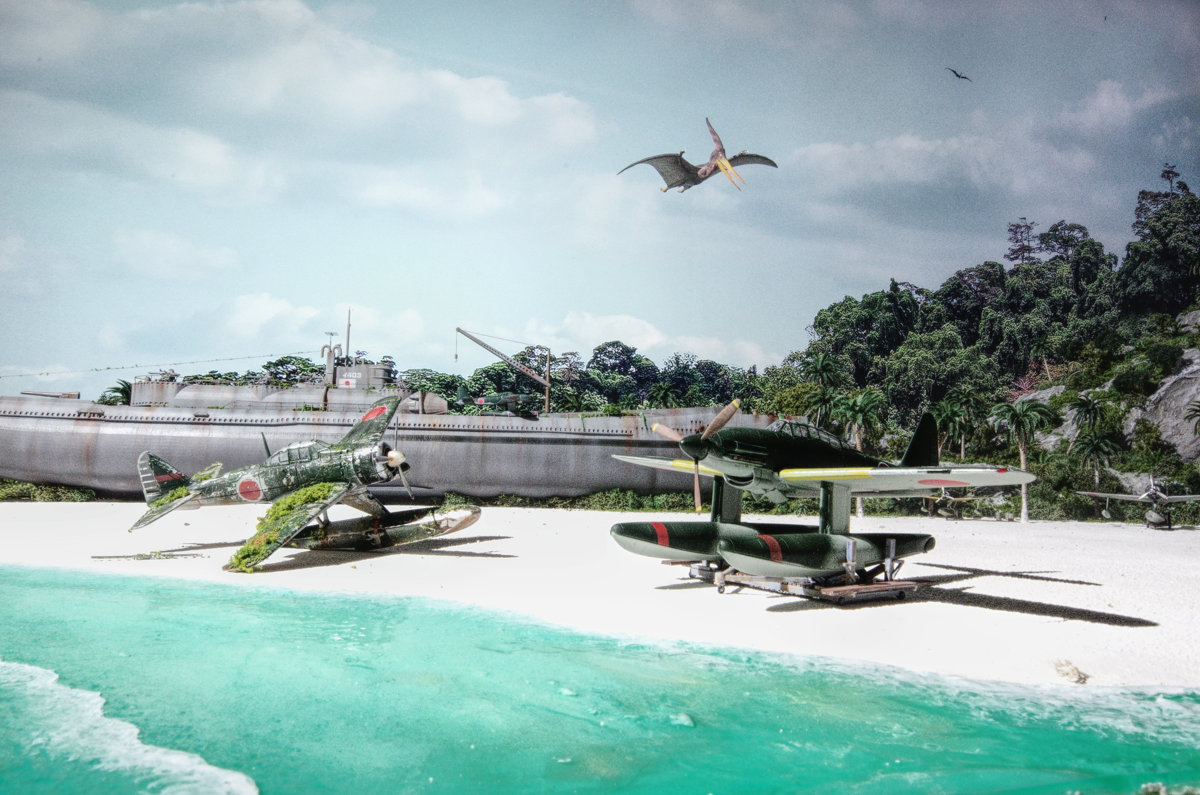
Unused beach scene photo from Warbird Island
For my recent book, Warbird Island, I went full Harryhausen, building an entire six foot diorama of a stretch of beach populated with dinosaurs and a three foot scale model of a Japanese submarine in my basement. I once read a quote from H.P. Lovecraft regarding the craft of writing, and it was his contention that a writer should approach every story as if he were preparing to perpetrate a hoax. I took this idea to heart and, even though Warbird Island is a work of fiction, it is VERY well-researched historical fiction. Even the dinosaurs are as accurate as I could make them. Did you know that Tyrannosaurus actually had lips? Unlike the popular Jurassic Park depiction of the king of beasts, with its legendary toothy overbite, the actual t-rex had a mouth more like a lizard. (This was determined by patterns of wear on its fossilized teeth in a recent research paper.) Unfortunately, the handful of lifelike t-rex replicas available to me at the time had not caught up with the science, and I ended up having to compete with a horde of rabid online dinosaur toy collectors to chase down a realistic replica. (Artist's do not starve simply because it pays poorly. We spend a LOT on art supplies.)
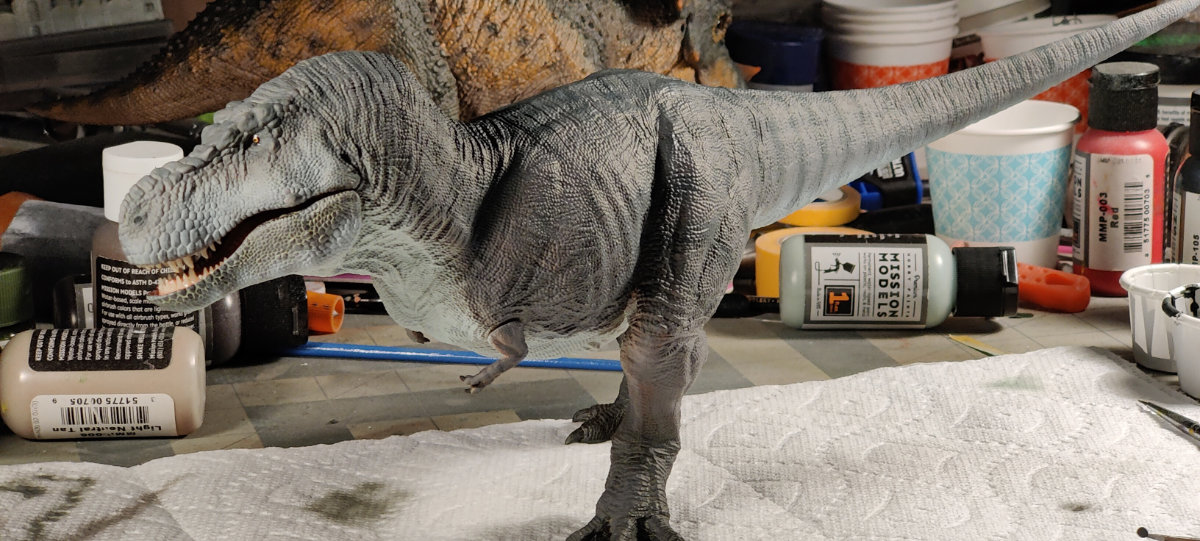
T-rex (with lips) getting a makeover for his photo shoot.
My use of models for Warbird Island included the book's cover art, which was largely created in camera. I photographed a scale model of a Corsair and a modified Pteranodon model (one of Revell's repops of the old Aurora snap-together kits, which I embellished with a more realistic 3D-printed head and talons, and copious amounts of putty) in front of my diorama, then digitally removed the support stands and overpainted the resulting photo to make it look more like vintage pulp magazine art.
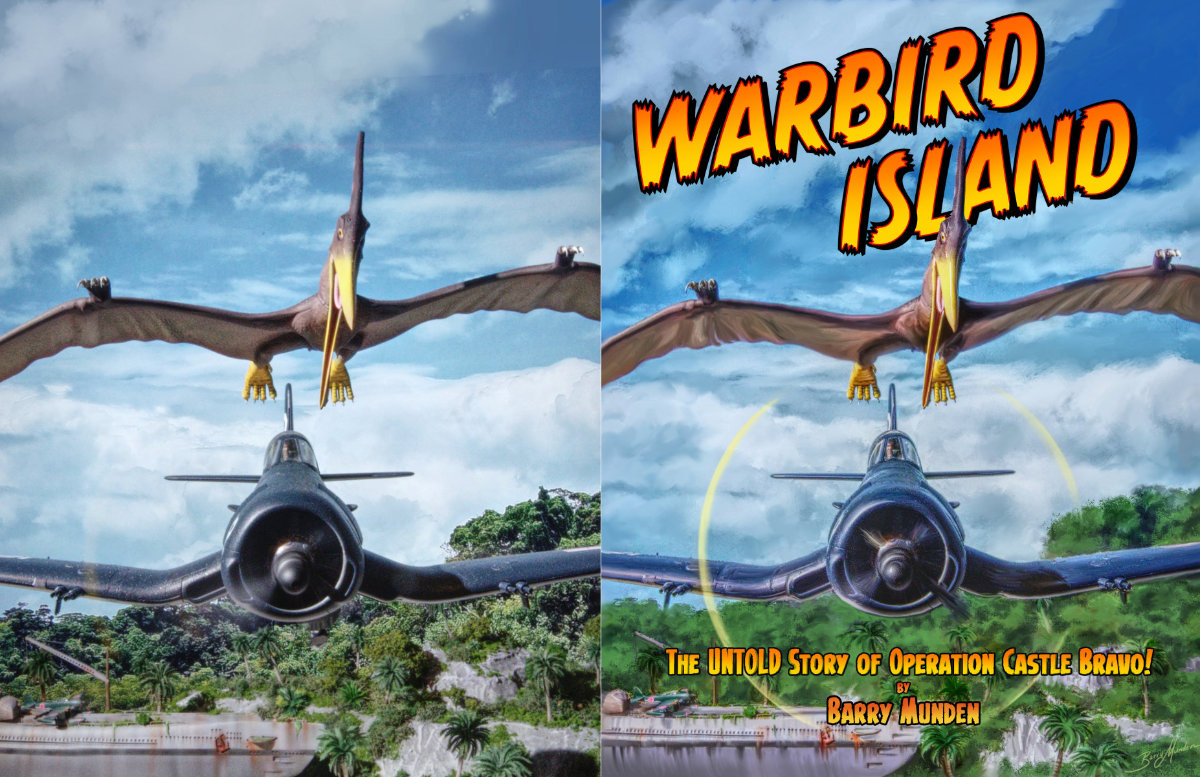
Warbird Island raw photo (after animation stands removed) and finished art
Over time, I have slowly been turning my basement into a miniature film studio. The key elements include a purpose built table (beefy enough to support the 75-inch flatscreen that often serves as a backdrop), physical backdrops (also used for light blocking), studio lights and an SLR camera with the obligatory wide-angle lens, tripod and remote. I custom built some animation stands for the models themselves, which is one of those pieces of equipment you do not think of as being terribly difficult to improvise until you actually need one.
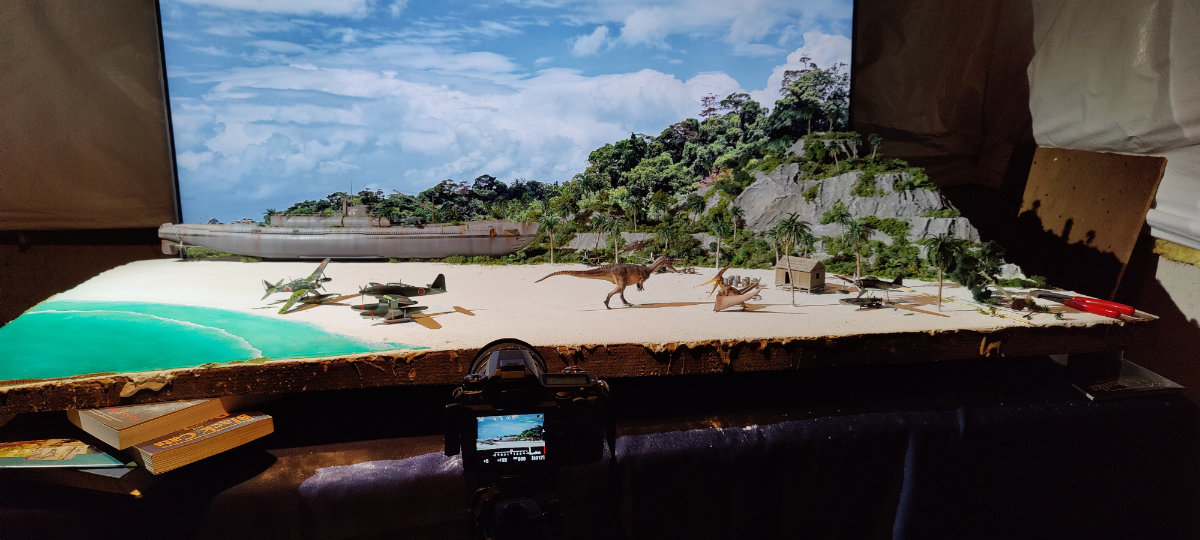
A wider view of the above beach scene
In another portion of my basement, located near my shelf of shame (modelbuilder's slang for the inevitable stash of unbuilt model kits), is a 3D resin printer which has proven invaluable for me to produce custom parts or even whole models. There is a wealth of downloadable stuff (of wildly varying quality) available online, but I have slowly and grudgingly learned to do some rudimentary 3D modeling myself, and the usefulness of my printer has grown exponentially as a result. It is expensive to feed and makes a ridiculously toxic mess, though, so I wouldn't recommend one unless you have a safe place to put it. Keep a mountain of nitrile gloves handy.
If all of that seems like a rather excessive way to produce an image, that is because it is. It's slow and expensive and time-consuming. I could probably have hand-painted the cover image of my book in less time and for far less money. But I had a lot of fun and created something unique, so I have no regrets. I also ended up with some physical artifacts afterwards, which made great kickstarter prizes. They also proved to be useful drawing reference for the graphic novel itself, which is one of my favorite uses for models. Most of the very best aviation painters in the world have a mastery of perspective drawing, which includes the ability to generate 3-dimensional views of aircraft in any position based upon three-view scale drawings. I am not one of them. Basic perspective is baked into my DNA after decades of drawing, but perspective projection is a technical skill that continues to confound me. It is a tedious process involving a LOT of construction lines whose endpoints always seem to lie halfway across the room somewhere, and it seems simpler and more useful for me to just have a model airplane in front of me that I can position and light however I like. Both methods have their pros and cons, but only one of them gives me a toy airplane, so I like that one.
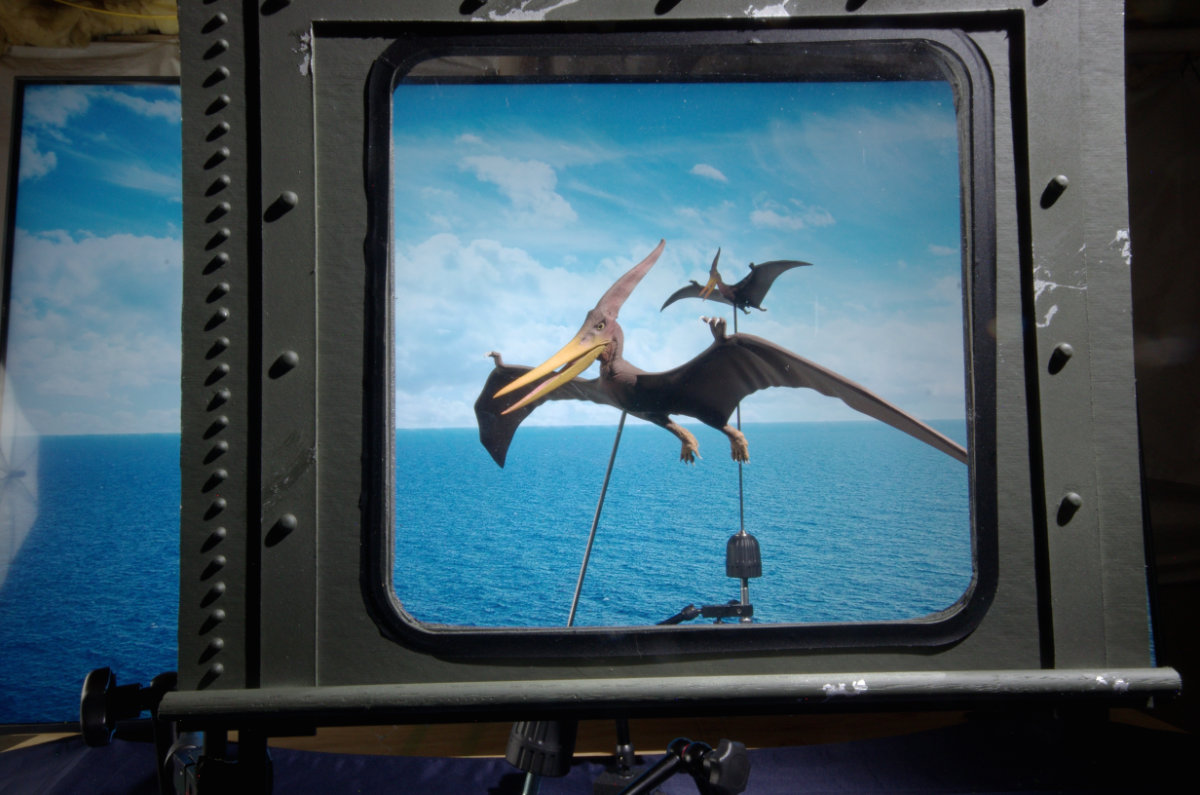
Unused pterosaur photo set-up showing animation stands and faux helicopter window
Building models for the camera is more akin to production SFX work than traditional modelbuilding. I generally only build for what the camera sees, and every model has to accomodate the demands of being mounted and photographed. The model needs to have a mounting point, props need to spin, lighting may need to be installed, weathering has to be heavy enough to be visible under studio lights, reflections from decals need to be minimized and there is no point in detailing stuff that won't be seen.
Building the models is only half the battle. The other half is photographing them, and that requires both quality equipment and (more importantly) the skills to use it to get what you want. Your own lack of knowledge and experience is more likely to be a bottleneck than your gear. 21st century photographic technology is almost uniformly amazing. My own gear is very modest (a ten year old Pentax K-5 with a couple lenses, which my cell phone camera often puts to shame), and I still find new ways to squeeze better images out of it. There is a wealth of information on youtube about how to take good photos, so I won't waste time on that here. The knowledge specific to photographing miniatures realistically is best found by researching old-school VFX techniques. You will see the term 'depth-of-field' come up a lot. That's why you want a wide-angle lens: to help you keep everything in focus when shooting up close. One of the modern masters of miniature photography is Felix Hernandez, who offers an inexpensive and comprehensive course on miniature photography that I recommend, if you are truly interested in learning more on the subject.